Posts

Retaining Soil Moisture in Garden in the Pacific Northwest Durng the Adverse Dry Condtions of Climate Change 2021

Image
This year's (2021) dry-hot summer in the Pacific Nortwest resulted in marked loss of soil moisture. For soils with predominant sand texture (e.g. loamy sand), the loss of soil moisture resulted in permanent plant wilting/drying, especially, those plants with shallow roots - within 6 - 10 inches of topsoil. Under these conditions of adverse changing climate, one challeng for a gardener/farmer is to determine/identify factors for moisture retention, and plant growth with minimum or no irrigation. For such soils, one option to retain moisture for plant growth is by improving the soil structure using organic matter. Example: a single Kale plant is thriving well on organic mulch. Another example: Dandelion with very deep roots under an old wood is surviving. Perhaps the wood helping is retaining moisture. By Peter Emau

Sustainable Gardening in Challenging Climate Change

Image
In the Pacific Northwest, like other areas, this year 2021 has seen clear changes in climate. In the Pacific Northwest, the specific changes included prolonged drought-high temperatures during the spring-summer. One challenge for a farmer, under this conditions, is how to sustain gardening throughout the year with minimal or no irrigation/watering to grow healthy vegetables foods. The challenge is more acute for a combination of soils (such as sandy soils when compared to clay soils) that have relatively little capacity to hold moisture; and for plants with shallow roots (e.g within the top 6 - 12 inches of soil/garden surface). Perhaps we can learn from the plants themselves as shown in the following pictures: A: The leaves of grass with shallow roots ( mostly with the 6 inches layer of top soil) on sandy loam soil (16% Clay; 13% silt and 71% sand) has driedied-up due to prolonged drought (at least 2 months without rain): B: The roots (bunch type are) dried-up as well. C: Ho...

Pasture Grazing Goats and Chickens together: A Positive Combination

Image
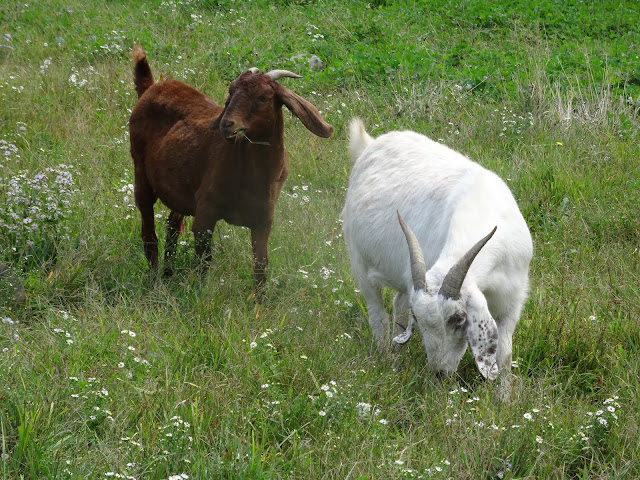
by Peter Emau: A goal of EMAU FARMS LTD is to raise livestock and poultry in pasture consistent with nature. Here we show pictures of such activities: While the goats search for and graze on fresh pasture (leaves, stems etc), the chickens search and eat the insects/worms etc that run away from the goats.

Fifteen-Minute Gardening- Sustainable Agriculture

Image
by Peter Emau One common challenge in sustainable agriculture is finding enough time for growing healhty foods. At this time of COVID pandemic, most people are forced to work from home. Therefore, there is an opportunity to allocate time (break time) for gardening. We tested one option of dividing the garden into plots equivalent to tasks that can be completed within 15-minutes, assuming one takes a 15-minute break and spends that time to complete a sepecific garden task (e.g, sowing, planting, weeding, harvesting) on a single plot. We divided the garden into 6ft x 6ft plots ( i.e 2 meters x 2 meters) for which such a a specific garden task can be completed by one person within 15 minutes. The size of the plot may vary for each person. This 15-minute break provides not only healthy mental and physical activity for the brain and body (that can be beneficial for the work), it provides time for grow healthy foods. Below is an examples of garden plots:

Testing the Adaptability of Growth of Finger Millet (Eleusine carocana) in Mansfield, Ohio During the 2017 to 2019 Summer Growing Seasions

Image
by Peter Emau One objective of EMAU FARM's sustainable agriculture program is to establish and preserve grains such as finger millet- that has been used for many generations as stable food in many regions of the world. Birds, including poultry, also love to eat millet.  Specifically, the objective is to test the growth, of different varieties of Finger Millet from India and Africa in Ohio, US.  The challenge for Ohio is that growth of Finger Millet is affected not only by the climatic conditions, but also by the photoperiodism (.e. Finger millet is a Short-day plant, for which onset of flowering requires long nights of approximately 12 hours ).  Thus, plants will need to be ready to start flowering by August- September (when the day-length decreases from 13 or less hours/night-length increases from 11 or more hours a day).  The ideal variety would be that which requires 10 - 11 hours of darkness to start flowering; which would mean it starts flowering by early August...

EMAU FARMS - PASTURED GOATS SEPTEMBER 2019

Image
By Peter Emau Today, we go we walk through goats in Pasture in EMAU FARMS LTD .

EMAU FARMS- Growing Finger Millet- A Photographic Walk Through in September 2019

Image
By Peter Emau One goal for EMAU FARMS LTD in 2019 was to grow finger millet varieties for potential human, animal or poultry feed.  We used a sustainable system of gardening. Here is a photographic walk through of different varieties of Finger Millet growing; and the status of their growth Finger Millet- Musei Variety-100% FSG Plots seed heads on 21Sept2019 planted on 28May2019 Finger Millet- Musei Variety 19 Finger Millet- Ekama Variety- FSG Plot 100% Seed heads on 21Sept2019 planted on 28May20 Ekama Millet Variety Finger Millet Zambia Variety - 61.5% Seed Head on 21Sep2019;  Planted 28 May2019 Finger Millet Zambia variety- Seed Head Close-up Finger Millet Zaire Variety - 72.7% Seed Head on 21Sep2019;  Planted 28 May2019 Za ire Variety- Seed Head Close-up Finger Millet Zaire Variety - 73.3% Seed Head on 21Sep2019;  Planted 28 May2019 Zaire Variety- Seed Head Close-up Finger Mille...